Alger Hiss, Whittaker Chambers, and the Dogs That Didn’t Bark
by Peter Irons
A Response to “The Big Kisseloff”
by Harvey Klehr, Commentary, April 16, 2025
2
Alger Hiss, Whittaker Chambers,
and the Dogs That Didn’t Bark
An essay/review by Peter Irons
Inspector Gregory: “Is there any point to which you would look to draw my attention?”
Sherlock Holmes: “To the curious incident of the dog in the night-time.”
Gregory: “The dog did nothing in the night-time.”
Holmes: “That was the curious incident.”
“The Adventure of Silver Blaze,” Sir Arthur Conan Doyle, 1892
Invoking the creator of Sherlock Holmes for solving the Hiss case is not entirely facetious, but clearly needs some explanation and background. With his aid, it can now be said that Whittaker Chambers lied about the crucial aspect of his story that Alger Hiss, as a mid-level State Department bureaucrat, turned over sensitive documents to Chambers, a self-confessed underground Communist Party courier, during 1937 and 1938, for copying and transmission to Soviet spy-masters.
The occasion for such certainty is the publication by the University Press of Kansas of “Rewriting Hisstory: A Fifty-Year Journey to Uncover the Truth About Alger Hiss,” by veteran journalist Jeff Kisseloff. The book not only makes a solid argument for Hiss’s innocence but in the process also exposes as fraudulent the entire right-wing apparatus devoted to putting an end to liberalism by painting the New Deal administration of President Franklin Roosevelt, and the Fair Deal policies of his successor, Harry Truman, as infiltrated and influenced by Communists whose loyalties lay in the totalitarian Kremlin regime, not the democratic values of the country to which they professed allegiance. That may sound hyperbolic, but in many ways the Hiss case fueled the phenomenon known then and now as McCarthyism. Conclusive evidence of Hiss’s innocence would shine an entirely different light on that frightful era in American history.
Kansas’s decision to publish Kisseloff’s book quickly (and predictably) provoked attacks from the band of long-time Hiss accusers, who resorted to vulgarity and Red-baiting against me and Kisseloff, which I’ll address below in showing their extreme defensiveness and evasion of the evidence we both present that Hiss could not—and did not—commit espionage as Chambers charged.
It was Kisseloff’s book that revived my also-fifty-year involvement in the case, which began in 1970 with research for my PhD dissertation at Boston University on the domestic political roots of the Cold War and McCarthyism (an expanded and updated version was published in 2024 as Cold War Crusaders: Harry Truman and the Architects of McCarthyism). To my surprise, I discovered in the Truman Library in Independence, Missouri, records pointing directly at a group of anti-communist activists, both inside and outside of government, who had charged Hiss since 1939 with membership in a Communist Party “cell” in the New Deal’s Agriculture Department in 1933 and 1934. Influential members of this group intensified their campaign against Hiss when he moved to a State Department post in 1936, his goal since attending Harvard Law School as a protégé of FDR’s top talent recruiter, Professor Felix Frankfurter, anathema to New Deal opponents as a radical, which he wasn’t.
My dissertation findings prompted me to contact Hiss and volunteer as a researcher for his ultimately unsuccessful coram nobis petition seeking to vacate his conviction on evidence of prejudicial governmental misconduct before and during his two trials in 1949 and 1950. A federal grand jury in New York had indicted Hiss on two perjury counts—the statute of limitations for espionage had expired--for having denied meeting with Chambers after January 1937 (a year during which Chambers claimed Hiss had given him documents on a regular basis) and for denying any espionage itself.
After prosecutor Thomas Murphy confessed to the first Hiss jury that “[I]f you don’t believe Whittaker Chambers, then we have no case,” four jurors didn’t believe the government’s star witness, forcing a do-over trial with a new jury. Murphy did not repeat his invitation to disbelieve Chambers, and secured a unanimous guilty verdict and a five-year federal prison sentence for Hiss.
It was in his State Department position with the Trade Agreements Division as deputy to Assistant Secretary Francis Sayre that made Hiss a target of renewed efforts to oust him, well before he accompanied FDR to the Yalta Conference in Crimea in February 1945 to negotiate post-war aims with Churchill and Stalin, and then served to wide acclaim as presiding secretary of the United Nations’ founding conference in San Francisco that June, shortly after Truman replaced Roosevelt as president.
The campaign against Hiss took a public turn in 1948 when, in an effort to influence the presidential election, the House Committee on Un-American Activities (HUAC) brought in Whittaker Chambers, to name Hiss and others as secret Party members. Only after Hiss sued Chambers for slander (spoken untruths) and during pre-trial depositions in Baltimore did Chambers, after Hiss’s lawyer, William Marbury, asked for any proof to back up his story, appear on November 17 (after Truman’s come-from-behind victory over Thomas Dewey) with a manila envelope holding some 65 sheets of standard typing paper, reproducing documents that appeared to be summaries and copies of State Department documents. And only then did Chambers retract his denial, several times under oath, that Hiss had engaged in espionage. But it was the so-called Baltimore Documents, retyped from originals, that most directly pointed to Hiss as their source, since several had his initials or handwritten notations. And since the original documents had been retyped by someone, the obvious questions were: who did the typing, where and when was it done, and on whose typewriter?
Chambers had the answers: the typing was done at night by Hiss’s wife, Priscilla (he first named Alger before learning he couldn’t type); it was done at the Hisses’ homes from the spring of 1937 through April 1938, although Chambers had previously claimed a dozen times, several under oath, that he had left the Party and the underground in 1937 (the dates kept shifting as Chambers kept tripping over his own story); and on a typewriter the Hisses had owned. Under repeated questioning by FBI and State Department security agents, Chambers stuck to this basic story: Every week to ten days during those years, Chambers would visit the Hisses’ homes in Washington, the first at 1245 Thirtieth Street, NW, on a quiet, narrow street in what was then a sleepy Georgetown, with brick and wood row houses occupied by hundreds of federal workers in professional and managerial jobs, many of them lawyers like Alger Hiss. And it was the Hisses’ neighbors on both sides of their 13-foot-wide, two bedroom and one bath, 784 square foot, wood-frame house, who provided the evidence that convinced me, along with the exhaustively researched and documented account in Rewriting Hisstory, and other evidence I gathered, that Chambers’ stories about the document exchanges—more than a hundred night-time and early-morning visits over two years at two different houses, he claimed—were literally incredible and virtually (although that’s an unnecessary caveat) impossible.
And here’s how Sherlock Holmes helped to expose Chambers as a liar. In “The Adventure of Silver Blaze,” Holmes has been asked by local police in the rugged Dartmoor area to help investigate the mysterious disappearance of a famous racehorse from his stable, on the eve of a high-stakes race in which he is the prohibitive favorite. Although a stable-boy slept in the hay loft along with a guard dog, searchers for Silver Blaze found the boy in a drugged stupor; their search also found his trainer’s body some distance from the stable, his skull crushed by a heavy blow. Suspicion falls on the neighboring owner of a competing horse, a man with a lead-tipped cane and a violent temper.
But Holmes is skeptical. On their train ride to Dartmoor, he cautions Dr. Watson: “It is one of those cases where the art of the reasoner should be used rather for the sifting of details than for the acquiring of fresh evidence.” Exhaustive searches had turned up nothing new and the basic facts seemed clear: someone had entered the stable after drugging the stable-boy through his dinner, and had taken Silver Blaze. It also seemed clear that his trainer had chased after the thief but was murdered by a heavy blow to his skull, as Silver Blaze bolted across the moors, yet to be found. But that scenario didn’t convince Holmes, prompting the exchange above with Inspector Gregory. Had the intruder been a stranger to the stable dog, it would have barked, awakening those in the close-by house, even with the stable-boy comatose. But no one heard the dog bark. “Obviously,” Holmes concluded, “the mid-night visitor was someone whom the dog knew well.” After many Holmesian plot twists, it turns out the trainer himself was the guilty party, but had died from a kick to his head by his own horse. Doyle called this one of his most inventive Sherlock Holmes stories of 56 he wrote.
So, what’s the relevance of this story to the Hiss case? Because, according to the Hisses’ adjacent neighbors on Thirtieth Street, it would have been impossible for Chambers to have come and gone more than a hundred times without being detected, not only by the neighbors but also the Hisses’ two “barky” cocker spaniels who shared the tiny house with them. If Chambers is to be believed (always risky), he would sometimes enter the house at 2 a.m. to exchange documents, claiming at one point that Hiss had given him a house key, a serious breach of espionage rules, although undoubtedly a lie; agents were instructed never to meet a source at their residence, to avoid surveillance, and to meet only in public places. Even with a key, it strains credulity to believe the little spaniels would not have awakened the whole block of squeezed-together houses on a quiet street with their middle-of-the-night barking, and with the Hisses’ front door easily visible to awakened and curious neighbors. But, unless the neighbors on both sides were lying, deaf, or both--and not one of Hiss’s accusers has ever suggested that, simply ignoring this crucial issue altogether--Chambers was the liar, not Hiss. And if Chambers did not exchange documents with Hiss as he described, neither he nor anyone else has ever offered another, plausible alternative scenario for the “who, what, where, and when” questions that such an account would raise, but that Hiss’s accusers, both then and now, have failed to address, and which are fatal to supposed “proofs” of Chambers’ veracity.
There is a multitude of other problems with Chambers’s shifting stories, exposed brilliantly in Kisseloff’s book (with more than a touch of self-deprecating and wry humor) but this, to me, is the clincher: No night-time barking, no Chambers. No one hearing late-night typing, no Chambers and no Hiss case. No Hiss case, Joe McCarthy loses Exhibit A of Communist perfidy. What might then have happened is purely speculative, but the country might have been spared decades of conflict between progressives of various stripes and causes, but with a shared commitment to liberal and democratic values, and those who accuse their opponents of being “un-American” while using un-American tactics of repression and division against them.
Exposing the Hiss case as a fabrication, as Jeff Kisseloff convincingly argues and documents, is an important step in reclaiming our real history from those who refuse to honestly confront their critics or the facts, ignoring the most damaging and cherry-picking others out of context to fit square pegs into round holes. And the biggest hole is the uncontroverted and highly credible testimony and statements of the neighbors on both sides of the thin walls barely separating them from the Hisses, as this photo of the three adjoining houses shows better than a thousand words.
The most convincing evidence of Chambers’s lies and Hiss’s innocence is found in the transcript of an interview in 1999 by Kisseloff (cited but not quoted in his book) of Dr. Elizabeth May, a Treasury Department economist who lived next door at 1243 Thirtieth with her husband Geoffrey, a lawyer with the Social Security Board. Her credibility was unshakable; she had an economics doctorate from the London School of Economics, served later as the first female director of the Export-Import Bank and as a college president, and lived to the age of 103! By her account, she and her husband were active and enthusiastic New Deal liberals, political views she said they shared with Alger and Priscilla Hiss and frequently discussed and debated with them over cocktails. Her first-person story destroys every aspect of Chambers’ claims to have repeatedly visited the Hisses as an underground Soviet espionage agent; it’s worth quoting here, with paraphrased questions from Kisseloff:
“We knew them quite well. We were new to Washington. And they had moved in and were friendly. We didn't know them in terms of the work we did, but Priscilla and I were both interested in good works, the League of Women Voters and that sort of thing. We were activists. The League of Women Voters was liberal activist in its concern about the failures of government in the District of Columbia. When there were [congressional] hearings going on, I'd tell her or she'd tell me and we'd go together, and we'd exchange ideas.”
[Did they ever express Communist ideas?] “Oh, no! My husband and I, we just couldn't believe that any of those things that were said against them could possibly have been true. Alger wasn't conservative, but he wasn't the opposite of that, either. His views were sound and solid and academic.”
[The Thirtieth Street houses left little room for privacy] “These were old houses that had been there a long time and had just been remodeled and were very small and very, very compacted. You had trouble when you had company, and you couldn't find a place to store things. … The houses both adjoined. They mirrored each other, and there was also hardly any separation between the houses. For instance, if you looked through the little hole for [razor] blades in the bathroom, you could see into the other house. That shows you how close they were, and you could hear everything, too.”
[Could you have heard Priscilla typing?] “Oh, sure. The walls were paper thin, and those old typewriters were very noisy. And where would she have it? We had twin beds in one room [adjoining the Hisses’ bedroom], and that left hardly any space to walk around. The other [upstairs] room was very tiny. Here's a couple with a child [Priscilla’s son Timothy Hobson, ten years old in 1936, whose tiny bedroom was just above the front door]. Where could she sit and work like that? And if they were having regular meetings with anybody, we would had to have seen that person. We could see their front door from our house. These houses were so close, every little sound went through,” adding that she and her husband would certainly have heard the dogs barking, especially on humid, window-opening nights in sleepy Georgetown. She also noted that the tenant who replaced the Hisses when they moved in December 1937 was a sportswriter whose late-night typing was clearly—and annoyingly—audible, compared with the previous silence. Although Geoffrey May testified for the defense at both trials, telling the jurors what his wife later told Kisseloff, they obviously ignored this credible refutation of Chambers’s story of a hundred-plus undetected visits at all hours of the night.
The accounts of the Mays were corroborated by James Robb, a government lawyer whose house at 1247 Thirtieth was squeezed against the Hisses on the opposite side and was equally exposed to sounds from next door. In a letter to Hiss, Robb (who moved to Arizona before Hiss’s trials and did not testify) wrote that he “could plainly hear” sounds from next door, especially Tim Hobson’s piano playing (Chambers didn’t recall any piano when—inaccurately—describing the layout and furnishings in the Hisses’ house to the FBI; it took up a big chunk of the living room). “I can certainly attest to the fact,” Robb wrote, “that our life and yours were perfectly normal and while I don't think I'm nosey my cowboy training taught me early to ‘cut sign’ and watch for tracks and I never saw or heard anything to be even slightly suspicious of goings on at 1245 30th St.”
Further evidence that Chambers lied was his statement to the FBI that he had a “friendly” relationship with Tim Hobson, who denied ever seeing or hearing Chambers. During this time, Tim was house-bound for several months after an almost fatal bicycle accident in Febuary 1937 that put a leg in a cast; Chambers flubbed his coaching, unable to recall that Tim was even in an accident. It is by sifting through such seemingly minor details, as Holmes showed in “Silver Blaze,” that reveals Chambers as the liar in the case, undetected, unfortunately, by the jurors who convicted Hiss.
For his part, Tim would later volunteer to testify that he never saw Chambers in the house. His stepfather refused to let him appear after getting word that the FBI had been inquiring about Hobson’s homosexuality (for which he had been dismissed from a Navy officers program) and would be willing to use that information against him at trial. At the same time, and out of fear of disclosure, the FBI and prosecutors kept Hiss’s lawyers—and the jurors—from learning of Chambers’ own confession to the FBI of his “compulsive urges” to seek out strangers for furtive sex in public bathrooms and flea-bag hotels, something no real espionage agent would risk. But that was a time of rampant homophobia, and Alger said he’d rather go to prison than see Hobson treated that way. Years later, Kisseloff asked Hobson why anyone should believe him when testifying to his parents’ innocence (although Priscilla Hiss was not charged, the prosecution let the jurors know of her alleged role in typing the Baltimore Documents). And he found Hobson’s forthrightness to be telling. “I didn’t love them enough to lie for them,” he said. Put against each other, Tim Hobson (who later became a noted surgeon) is clearly more believable than Chambers in denying any nocturnal visits right beneath his bedroom. (Had jurors been allowed to visit the two Hiss residences, under judicial supervision, which court rules would have allowed, I seriously doubt they would have bought Chambers’ story about visiting what he called the “headquarters” of a major espionage apparatus he allegedly directed).
Further widening and deepening this hole in Chambers’s accounts of visits to the Hisses was his claim that, after Priscilla Hiss must have spent countless night-time hours at Thirtieth Street retyping what must have been thousands of pages of State Department documents (none of which were ever seen or reported missing, or showed up in later-opened Russian files), she continued the retyping at the Hisses’ new residence at nearby 3415 Volta Place, into which they moved on December 29, 1937, a roomier house but also cheek-by-jowl with neighbors on one side with facing entrances. All the so-called Baltimore Documents were dated between January 5 and April 1 of 1938, and were supposedly typed on the Hisses’ old Woodstock office machine, to be picked up and returned by Chambers. But once again, the cockers failed to bark at an unknown night-time visitor, and neighbors reported hearing or seeing no one remotely resembling Chambers during those months. And during numerous FBI interrogations, Chambers could recall nothing about the Volta Place house he supposedly visited on a regular basis in 1938, after claiming a dozen times to have quit the Party and his supposed espionage duties in 1937. As Kisseloff rightly notes, it’s hard to believe that Chambers—let alone anyone—could have forgotten the date of an event he claimed pit himself and his family in danger of Soviet retaliation for his defection, so much that they fled to Florida with $2000 stolen from the Party. That’s not conclusive proof he could not have made night-time visits to either house, but his story was totally lacking in corroboration, even any mention of how he got to and from Georgetown, how he knew when to visit, where he came from, by foot, car, or taxi, there being no public transportation from Georgetown to Union Station for trains to Baltimore and back to photograph documents, as Chambers claimed. For that matter, why retype any at all, instead of more quickly and quietly photographing them, as he claimed to have done with most? To my knowledge, no one—including Hiss’s lawyers--ever asked these obvious “how” questions that might—or might not—corroborate his stories, perhaps because he could not answer them).
The separate question of whether the Hisses even owned a Woodstock after the move to Volta Place, or gave it during house-moving to their maid for her sons to use, has been long disputed, with varying recollections that Kisseloff sifts through in his book, reaching a common-sense conclusion that the Woodstock changed hands during the December move, or a Woodstock, but not the one produced at trial by Hiss himself, a seemingly inexplicable and inculpatory act if it had in fact produced the retyped documents, although Kisseloff (who now owns the infamous Woodstock) convincingly shows it was not the guilty machine but a forgery; this part of Kisseloff’s book—which his detractors have thus far ignored—is an amazing feat of forensic investigation. But at the least, no one can connect Chambers to Thirtieth Street or Volta Place, Woodstock or not. That fact alone would certainly create a reasonable doubt in a conscientious juror’s mind, added to numerous examples of his lies about Hiss.
There were, as Kisseloff recounts in point-by-point detail, dozens of such “reasonable doubt” holes in the prosecution’s case, much of it from perjured or coached testimony. Unfortunately, Hiss’s lawyers failed to exploit the impossibility, or at least improbability, of the stories Chambers told about the supposed document exchanges. Had jurors paid attention to this evidence, while trials in the same courthouse of a dozen Communist Party leaders for advocating the violent overthrow of the American government were garnering headlines the jurors must have seen, the tides of history might well have swept the Hiss case from the front pages and deprived Joe McCarthy of his prize exhibit of Soviet spying without detection by “soft on communism” Truman officials, and the beleaguered president himself. This again may seem hyperbolic, but McCarthy’s famous “Wheeling speech” in February 1950, just a month after Hiss’s conviction for having denied spying for the Soviets, allowed the fact-averse senator to decry the “traitor” in the State Department, waving a sheet of paper he claimed had the names of 205 Communists in the department funneling secrets to the Soviets. The rest is history, as they say.
Momentous events often turn on such seemingly trivial happenings, or, in this case, non-happenings. Had security guard Frank Wills not noticed a taped-open door in the Watergate complex on the night of June 17, 1972, who knows what might have happened, or not, without the investigations that ensued. Or if Franklin Roosevelt had not dumped Henry Wallace as his fourth-term running mate in 1944, replacing him with a fiercely anti-communist Missouri senator FDR barely knew. Historians are tantalized by such “what if” questions, but, enjoyable as they may be, what actually happened and its consequences is the proper focus. And, despite the unresolved question of who might have framed Hiss, and how, about which Kisseloff and I both have theories that independently agree, explored in his book and my recently published Cold War Crusaders, that does not undermine or disprove the evidence that Whittaker Chambers could not have received State Department records from Alger Hiss in the way he claimed, under oath and facing charges of perjury for lying, spared from prosecution himself by a last-minute and unprecedented appeal to the grand jury by Nixon, who knew a perjury indictment of the self-confessed perjurer Chambers would sink any prosecution of Hiss. But the serial perjurer has been shown, both here and in Jeff Kisseloff’s masterful autopsy of the case, to be a liar by “barky” cocker spaniels who did not bark at a non-existent Communist courier.
* * *
Given Jeff Kisseloff’s painstaking compilation, analysis, and conclusions about all the available evidence in the Hiss case, including some 150,000 pages of mostly unredacted FBI files he obtained through Freedom of Information Act requests and lawsuits, it was inevitable that the band of “Hiss was guilty” authors, dormant for years but always on the alert for critics of their certitude, would swarm from their hornet’s nest with stingers out.
The first to attack Kisseloff was retired Emory University history professor Harvey Klehr, author, co-author and editor of a dozen books since 1978 on Soviet espionage in the United States, real, exaggerated, dubious, or debunked. His 2010 book, Spies: The Rise and Fall of The KGB in America (written with John Earl Haynes and former Soviet intelligence agent Alexander Vassiliev), opens with a chapter on the Hiss case that ends “Case Closed.” Klehr might better have written “Mind Closed.” His “review” of Kisseloff’s book in the May 2025 issue of Commentary magazine is more a polemical hit-job than an actual review. In his lengthy response to Kisseloff, Klehr simply ignores all the evidence of Chambers’s lies about getting documents to and from Hiss for the Soviets, including all that is documented here. Klehr attempts instead to claim, based on hearsay accounts in Soviet-era files still hidden in Russian archives (if they still even exist) that the Soviets considered Hiss to have spied for them until his resignation from the State Department in 1946, although Klehr just rehashed in Commentary the “evidence” from Spies that Kisseloff had answered twenty years before. Klehr had nothing more to say about anything else in the book, especially the chapters dealing with the evidence in this article. By nothing I mean anything that might cast doubt on Kisseloff’s exhaustive research and its findings.
So Klehr turns (actually returns) to nasty, ad hominem, and phony charges against Kisseloff, whom he sniffily dismisses as a “freelance writer who has literally spent half a century denying that Alger Hiss was a Soviet spy [and] still refuses to face reality despite numerous indications in files from Russian archives that he had worked for Soviet military intelligence.” That’s a Red-baiting smear, with no citation to or quotes from any original Soviet documents; in fact, Klehr includes a supposed Soviet file listing Alger’s brother Donald (also a State Department official) as an espionage agent, a charge Klehr himself had dismissed as unfounded, casting serious doubt on everything in the unexamined Soviet files. As Kisseloff states unequivocally, he began his research with no commitment except to look for the truth; had he found evidence of Hiss’s guilt, he would have said so and presented it. Klehr was obligated as a reviewer and scholar to treat Kisseloff as a serious investigator. But he did not, resorting to the juvenile labeling of the book as “delusional madness” and Kisseloff as “dishonest.” But it is, I submit, dishonest of Klehr to simply ignore evidence of Chambers’ lies about obtaining documents from Hiss. That potato proved too hot for Klehr to handle, so he dropped it from his list of Kisseloff’s sins, assuming, I’m sure correctly, that Commentary readers would not notice this steaming omission.
I was so offended by Klehr’s nasty non-review that I composed a letter to Commentary, chiding him for unprofessional behavior and pointing out his evasion of the fatal flaws in Chambers’ stories of his relationship with Hiss. Much to my surprise, I got an email reply from Commentary chief editor John Podhoretz, dismissing me as a “Stalinist apologist” for Hiss. As a life-long democratic socialist, that Red-baiting libel understandably prompted me to demand apologies to both me and Kisseloff, replying to Podhoretz that I presumed he considered him a “Stalinist apologist” as well, to which I got this reply: “I don’t give a fuck what you might or might not presume. If you think I'm reading a word of your ludicrous apologetic nonsense your [sic] kidding yourself. Scram. You bore me.” I recount this episode (a former colleague of Podhoretz called him “permanently frozen in juvenilia”) as an example of the continuing defensiveness of Hiss’s accusers at any suggestion he might have been framed, with Kisseloff’s book the most dangerous yet, and with more vituperation sure to come.
The evasiveness of Klehr’s non-review is matched by two other anti-Hiss stalwarts, David Whittaker Chambers, grandson of his namesake, and George Edward “Ted” White (not to be confused with the noted historian Theodore “Ted” White), a law professor since 1972 at the University of Virginia and author in 2005 of “Alger Hiss’s Looking-Glass War: The Covert Life of a Soviet Spy.” A few words about each will dispel any notions that either came to the Hiss case with an open mind and a search for the truth.
Writing in the far-right Washington Examiner, Chambers first smears Kisseloff as “a pro-Hiss partisan, not a historian,” and his book as adding “nothing new” about the case. So much for letting his readers know what's actually in the book and the evidence and arguments it presents. Chambers then boasts that “I am a historian” and immediately commits an historical blunder, claiming that Hiss was a member in 1933 and 1934 of “the Ware Group spy ring” in the Agriculture Department (caps as if it was an actual espionage outfit, which it was not, as Chambers petit-fils should have known; no citations, of course). And then an even more amazing (and really hilarious) claim that “Even most pro-Hiss scholars agree that Hiss’s guilt was settled” after publication of Allen Weinstein's Perjury book and release of the Venona decrypts. My response: name one Hiss apostate and provide cites, which Chambers doesn’t have.
David Chambers might understandably be his grandfather's partisan. But there's no real excuse for White, holder of both a Yale PhD in history and a JD from Harvard Law School in 1970, to almost proudly refuse to engage with questioners at all. For the past 20 years, White has retreated behind a “Do Not Disturb” sign. When I read his book, and his claim that Tim Hobson and Tony Hiss were simply “dupes” of Alger, I asked White (who admits his :elitist” social views as a prep school and Ivy League product) if he meant that Tim and Tony lied to cover up Hiss’s espionage. His reply to me is an astounding admission of a closed mind, a violation of all scholarly norms. Pressed to respond, White wrote the following: “I can't think of anyone who had a greater incentive to believe their father innocent and a scapegoat [White is here accusing them of either lying or being stupid]. And no end of tireless research on your part will convince me that Hiss was other than a quite clever, dedicated Soviet agent who had a marvelous capacity to convince people he was other than that.” OK. But what if he wasn't, as Kisseloff and I both argue, with a boatload of new and corroborating evidence. Sorry,White says: “I made a decision sometime ago not to respond in print to critical comments about my work or to defend scholarly arguments I have made....” But I’m not surprised by either Chambers or White, just appalled at yet more slamming-the-door evasion by Hiss’s closed-minded accusers to convincing evidence of his innocence.
But the Hiss Wars, to use an apt phrase for a Cold War vestige, will continue, as a new generation takes a fresh look at grievous miscarriages of justice in American history, from the first Red Scare after World War One, to the post-World War Two Red Scare that produced the Hiss case and McCarthyism, and to the current Red Scare in which President Donald Trump and his acolytes baselessly accuse his foes, mostly moderate and liberal Democrats, of being “communists” who should be locked up, such as calling his 2024 election opponent “Comrade Kamala.” And, as the persecution and prosecution of Alger Hiss demonstrates, that kind of Red-baiting has long outlived the communist movement worldwide, and the Communist Party at home. But, as history teaches, and repeats its errors, an accusation of disloyalty—however fabricated—can ruin careers and leave an indelible stain on American history. That’s the lesson of Jeff Kisseloff’s gripping detective story and this essay. Certainly not the last words on the Hiss case, but challenges to the conventional wisdom that Hiss was undeniably guilty that must be taken seriously, as Hiss’s accusers have thus far refused to attempt.
-30-
Peter Irons is professor of political science, emeritus, at the University of California, San Diego, where he taught constitutional law and law-related courses from 1982 until his retirement in 2004. He earned a PhD in political science from Boston University in 1973 and a JD from Harvard Law School in 1978 and is a member of the US Supreme Court bar. He is the author of a dozen books on the Supreme Court and constitutional litigation; his most recent book, Cold War Crusaders: Harry Truman and the Architects of McCarthyism, uncovered crucial records on the Hiss case.
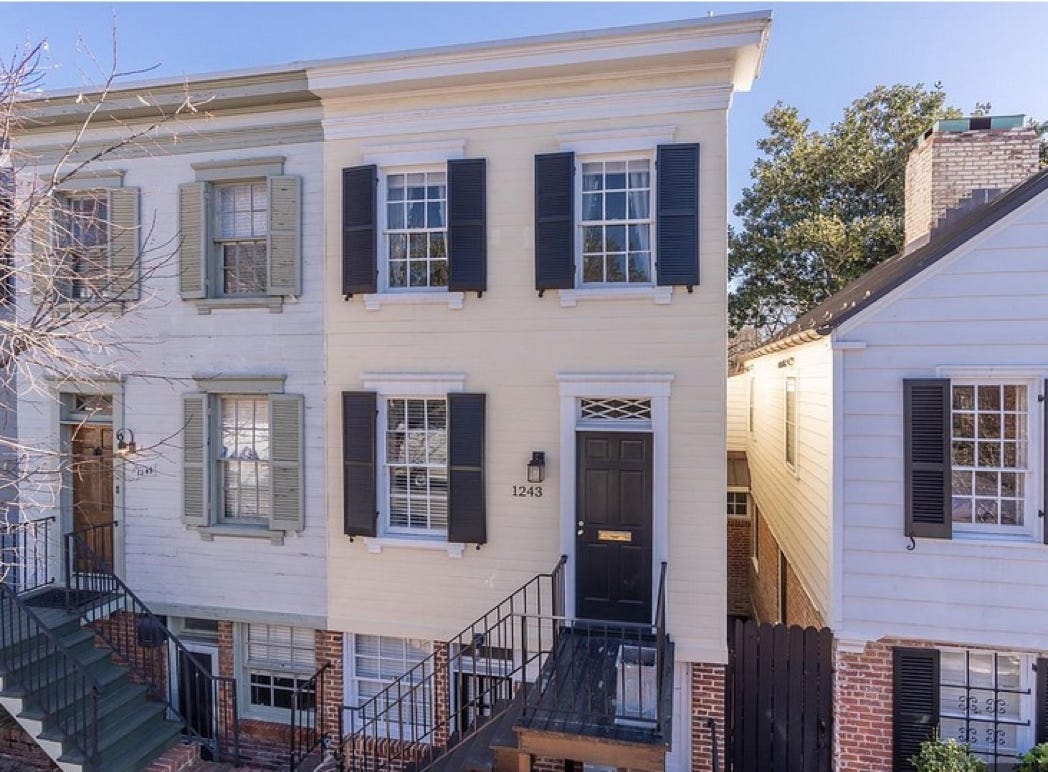
Two of the three side-by-side homes on 30th Street. The Hiss home was #1245 on the left. Geoffrey and Elizabeth May lived on the right at #1243. The Robbs lived at #1247, to the left of the Hisses’ home. It is out of the picture.
Rewriting Hisstory
A 50-Year Journey to Uncover the Truth About Alger Hiss
By Jeff Kisseloff

© Copyright Jeff Kisseloff.
All Rights Reserved.